Dec 4, 2018

Advent Calendar-Dec. 4


Snapshots Across America
Advent Calendar-Dec. 4


On day 4 of our Snapshots-Advent Calendar, we get our inspiration from the song written by Samuel Francis Smith, "My Country, 'Tis of Thee":


My country, 'tis of thee,
   Sweet land of liberty,
      Of thee I sing;
Land where my fathers died,
    Land of the pilgrims' pride,
      From ev'ry mountainside
  Let freedom ring!

The Gift of Freedom

The Oxford Dictionary defines Freedom as "The power or right to act, speak, or think as one wants." And to celebrate that, we recognize the Liberty Bell to "Let freedom ring".


Dec 3, 2018

Advent Calendar-Dec. 3


Snapshots Across America
Advent Calendar-Dec. 3


We continue our Christmas Advent with Day 3 with another of the gifts that we receive from living in America. Today we recognize that the  Declaration of Independence is one of the greatest gifts.

The Gift of Independence

In the Summer of 1776, delegates from all 13 Colonies had gathered at the Pennsylvania State House in Philadelphia. They unaminously agreed that it was time to declare their independence from Britain. On July 4, 1776 they formally issued the Declaration of Independence, and the birth of a new nation occured.


Dec 2, 2018

Snapshots-Christmas Advent Calendar-Dec. 2


Snapshots Across America
Christmas Advent Calendar-Dec. 2


As we follow up on Day 2 of our Snapshots-Advent Calendar where we are recognizing the gifts that we receive from living in America, we again turn to the Declaration of Independence for our inspiration, we are blessed by our "Creator with certain unalienable Rights, that among these are Life, Liberty and the pursuit of Happiness."

The Gift of Liberty

The Oxford Dictionary defines Liberty as "The state of being free within society from oppressive restrictions imposed by authority on one's way of life, behavior, or political views." Many people came to America to escape the oppression they lived under in other countries and live in America and enjoy Liberty. The Statue of Liberty has become the recognized symbol of that liberty.


Dec 1, 2018

Christmas Advent Calendar-December 1


Snapshots Across America
Christmas Advent Calendar-Dec. 1


As devoted Christians, we believe that this Nation, The United States of America, has been blessed by God from it earliest history, to become a Free Nation and that we are, as the Declaration of Independence states, "endowed by [our] creator with certain unalienable Rights".

In that context, we want to recognize many of those wonderful gifts by things and places that are part of the that we believe have came from God or those who believe in God. Each day from Dec. 1 through 24, we will highlight a place from somewhere in America that we believe represents those gifts.


Freedom of Religion

Many people pursuing Freedom of Religion came to America for the promise of having exercise their religion without persecution. One of the earliest incidents of this goes back to the Pilgrims who came across the Atlantic Ocean in the Mayflower arriving in Plymouth in 1620. They faced persecution in Europe for their religious beliefs and wanted to live in a place where they would be Free to worship God.


Sep 12, 2017

Fall, Football & Fort McHenry

Fall, Football, Fort McHenry and Francis Scott Key
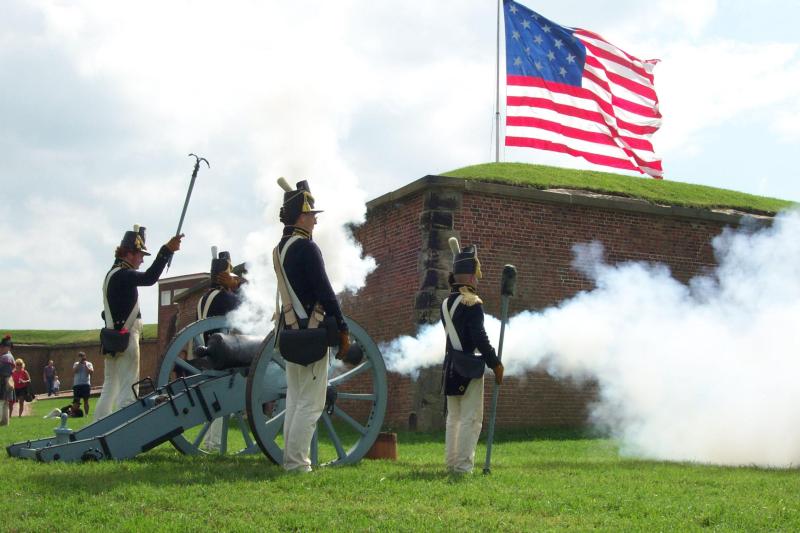


I have to say that Fall is my favorite season. Not just because of the colored leaves, cooler nights, cider mills and pumpkin patches, but also because it is the season of Football. Whether High School, which I used to ref those Friday Nights games under the lights, going to a College game on Saturday, or watching the NFL on Sunday and Monday nights. I just love football. But did you know what other famous event happened in the Fall? More specifically on September 13 & 14, exactlly 203 years ago: The Battle of Fort McHenry in Baltimore, Maryland in 1814.

That battle which was witnessed by a young American Lawyer, name Francis Scott Key from behind enemy lines, resulted in his penning of the lyrics to the Star Spangled Banner, which again is one of the great things I love about Football.

The Star Spangled Banner is one of the most performed songs in the United States, ranging from the smallest home town sporting events all the way to the largest televised event in America, the Super Bowl. While most Americans have repeatedly heard and quickly recognize the National Anthem, many may not know the unique circumstances nor the history leading up to Francis Scott Key penning the lyrics.

We go back to the setting during the War of 1812, which the Smithsonian’s website describes as “a relatively little-known war in American History” involving the British and a young United States. The first couple of years during that war, US forces were somewhat successful in many of the scattered skirmishes. However, after the British defeated NapolĂ©on in April 1814, they concentrated on the war against the United States. On August 24, 1814, the British took control of Washington D.C. and set the US Capitol Building and White House on fire. This was a demoralizing blow to the United States and the British’s next target was the strategic port of Baltimore, Maryland.1


As the British were advancing towards Baltimore, a series of rather unexpected events set into motion the strange circumstances where Francis Scott Key, a young American lawyer in Washington DC, witnessed the British attack on Baltimore, from behind enemy lines in the midst of the British Naval fleet.2

On August 28 an elderly Dr. William Beanes was arrested as a prisoner of war in response to several British soldiers being thrown into a local jail for accusations of pillaging and plundering Dr. Beanes’ and other’s homes. Friends and patients of Dr. Beanes persuaded Attorney Francis Scott Key to help get Dr. Beanes released. After getting permission and diplomatic status from President James Madison, Key and John S. Skinner, an official US prisoner exchange officer, approached the British Fleet under a flag of truce on September 7, 1814, to negotiate for Dr. Beanes’ release. There they met with British Major General Robert Ross, who agreed to release Dr. Beanes. However, since the three Americans were now aware of the British planned attack on Baltimore, General Ross ordered that they be detained until after the attack, so that they would not be able to alert the U.S. forces. So Key, Skinner and Dr. Beanes were caught up behind enemy lines in the midst of the massive fleet of over 50 enemy British Naval ships preparing for one of the biggest battles in the War of 1812.2

On September 12, the British launched a ground attack from the East side of the harbor that met significant resistance by the 3rd Baltimore Brigade under the command of U.S. General John Stricker. In the ground Battle of North Point, Major General Ross, who Key and Skinner had met with just days before, was mortally wounded. Despite their losses, the British forced their way to about two miles from Baltimore before holding their position awaiting for the British Navy to capture Fort McHenry. Later that day 16 British warships moved to within firing distance of that strategic fort that protected the Baltimore Harbor.

National Park Service Photo


 At 6:00 am on September 13, British cannons, mortars, and rocket launchers opened fire on Fort McHenry. Later in the day, three British warships approached the fort, but hastily withdrew after heavy US canon fire was returned. The battled raged all day and well into the night where rockets and exploding bombs lit up the smoky dark sky. At about 1:00 am under a blanket of night, the British attempted to land ground forces to the west of Fort McHenry. But two nearby batteries of US guns at forts Babcock and Covington, fired heavily for nearly two hours, turning back the enemy barges in their unsuccessful maneuver to make landfall and initiate a ground offensive from the backside. Throughout the night, the British continued with sporadic shells and rockets aimed at the fort.3

Despite the British launching an estimated 1,500 – 1,800 shells, morters and rockets aimed at Fort McHenry, US casualties were relatively small with only four deaths and twenty-four injuries out of approximately 1,000 defenders.4

Before dawn, the fighting had ended signaling that the battle was over, but Key and his companions didn’t know who had won. Then as told by the immortalized words he wrote “O, say can you see, by the dawn’s early light,” Key experienced great elation which “Gave proof through the night that our flag was still there”5.

Key, Skinner and Beanes were released from British detainment two days later on September 16. Key spent that first night of freedom in a quiet hotel room in Baltimore, finalizing his draft of the lyrics. The next day, on September 17, 1814, the Defense of Fort M’Henry was first published and distributed in Baltimore in the form of a handbill5. Over the next few weeks, it was published in numerous US newspapers and well on its way to becoming one of America’s most beloved patriotic songs. On March 3, 1931 The Star Spangled Banner was established by Congress as the official National Anthem of the United States of America.4

And that’s how a series of rather unusual circumstances, put a young American lawyer behind enemy lines to witness and be inspired by one of the greatest battles in US History, and Fort McHenry became the birthplace of a National Anthem. So the next time you hear or sing the Star Spangled Banner, whether while watching the Super Bowl or a hometown high school game, perhaps you may know a little bit more about its history and better understand the meaning and significance behind those familiar words.


The Snapshots Across America Game Card for Fort McHenry, Baltimore, Maryland.

https://snapshotsusagame.com


Fort McHenry, Maryland is also featured on the new U.S. Mint America the Beautiful Quarters and was released into general circulation on August 26, 2013.


Follow us for more Snapshots Spotlights about the many great tourist attractions
featured in the educational boardgame, Snapshots Across America.


Copyright 2014-15, Sandell Games.


Sources:

1National Museum of American History.  “The Star Spangled Banner, the Flag that Inspired the National Anthem.” Smithsonian Institute. Web. 18 Sept. 2014.

2Sam Meyer. Paradoxes of Fame-The Francis Scott Key Story. Annapolis, Maryland. Eastwind Publishing, 1995. Print. Pgs. 35-42.

3Harold R Manakee. “Anthem Born in Battle”. Star Spangled Books-Books, Sheet Music, Newspapers, Manuscripts and Persons Associated with “The Star Spangled Banner”. Eds. P. W. Filby and Edward G. Howard. Maryland Historical Society. Baltimore, Maryland. Print. 1972. Pgs. 29-39.

4Harold I. Lessem and George C. Mackenzie. “Fort McHenry-National Monument and Historic Shrine.” National Park Service Historical Handbook Series No. 5. Washington DC. National Park Service. Print. 1954. Web.

5Francis Scott Key. Defense of Fort M’Henry. Baltimore, Maryland. Circa 17 Sept. 1814. Library of Congress. Web. 

Fort McHenry National Monument and Historical Shrine website:
http://www.nps.gov/fomc/index.htm

US Mint America the Beautiful Quarters Websites:
http://www.usmint.gov/mint_programs/atb/
http://www.usmint.gov/mint_programs/atb/?local=FortMcHenry

Dec 6, 2016

Remembering the Attack on Pearl Harbor 
and the USS Arizona.


It started out as a quiet Sunday in Paradise, 75 years ago on December 7, 1941.
The Naval Base at Pearl Harbor as it looked prior to the attack on December 7, 1941.
(Photo by US Navy on October 13, 1941, less than 2 months before the attack)

The Japanese Empire had made several successful conquests on the Eastern half of the Pacific. They viewed the United States as their primary obstacle to dominating the entire Pacific Ocean region. The Japanese fleet, including 6 aircraft carriers loaded with around 450 aircraft, departed Japan on November 26, 1941. Radar from an American Army outpost had detected a large aerial formation shortly before the attack, but it was disregarded as they thought it was incoming flight of friendly planes from the mainland that they were expecting that day.

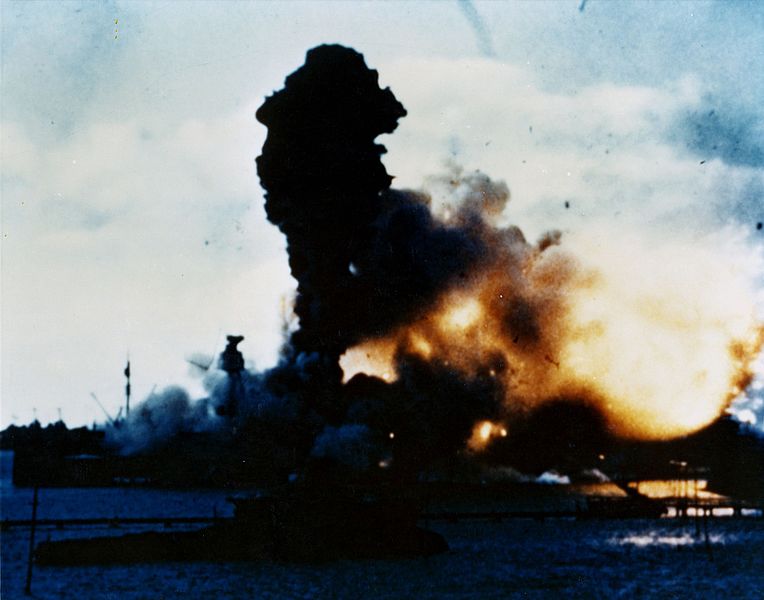
The forward  weapons magazine on the USS Arizona explode shortly after 8:00 am after being hit.
(Official U.S. Navy Photo)

The first wave of Japanese places attacked at 7:55 am, local time, and caught the U.S. Pacific Fleet stationed at Pearl Harbor completely by surprise. The enemy attack concentrated on “Battleship Row” and the six airfields nearby. Eight U.S. Battleships were put out of commission. 2,335 U.S. soldiers and 68 civilians lost their life in that attack

The USS Arizona sinking after being hit.
(Source U.S. National Archives and Records Administrationfrom the Franklin D. Roosevelt Library)

The USS Arizona suffered the worst damage of the entire fleet when its artillery magazine was hit, causing a chain reaction of explosions on the ship. 1,104 servicemen aboard it lost their lives in that attack, accounting for almost half of all the casualties from that day.

An aerial view of the USS Arizona Memorial straddling the sunken hull of the Battleship that sank in the Attack on Pearl Harbor.
(US Navy Photo by  Jayme Pastoric Cropped from original)

The USS Arizona Memorial is one of the most visited National Historical Sites in the United States. The next day, President Franklin Delano Roosevelt addressed Congress and the Nation. "Yesterday, December 7th, 1941 -- a date which will live in infamy -- the United States of America was suddenly and deliberately attacked by naval and air forces of the Empire of Japan."

In these troubling times, let us always remember the resolve and commitment that the generations who have gone before have done to protect our Great Nation and the Freedoms we have.


The USS Arizona Memorial, in Pearl Harbor, Hawaii, is one of the popular attractions featured in the latest edition of Snapshots Across America.

For more information on Pearl Harbor visit:


National Parks Teaching With Historic Places Lesson Plans


For more info on the Dr. Toy Award winning educational board game Snapshots Across America, visit our website at

www.SnapshotsUSAgame.com

Aug 15, 2016

Happy 100th Birthday to National Park Service

On August 25th, 2016 the U.S. National Park Service celebrates 100 years. We want to help celebrate the #NPS100 Birthday with our own Top Ten Lesser Known National Parks that are all featured in our educational board game Snapshots Across America.

#1-Mammoth Cave National Park
Kentucky


Our Top Lesser Known National Park is the largest discovered cave system in the entire world, with new passageways being constantly discovered. Archaeological evidence that has been found show that natives explored parts of the cave at least 4,000 years ago. Numerous guided tours take visitors to different sections of the cave, as well as additional "wild cave tours" are available to the advanced spelunkers.

Mammoth Cave National Park Website:


#2-Everglades National Park
Florida


The Everglades National Park protects the largest subtropical wilderness in the United States. It provides a critical natural habitat for many endangered species including the Manatee, American Crocodile and the Florida Panther. Visitors that come to the 1.5 million acre park enjoy hiking, biking, canoeing or tours through the many different habitat areas.

Everglades National Park Website:


#3-Mesa Verde National Park
Colorado


Mesa Verde National Park was established in 1906 by President Theodore Roosevelt. It preserves over 4000 archaeological sites including over 600 cliff dwellings and is the largest archaeological site in the entire United States. The structures made out of sandstone blocks using adobe mortar have been fairly well preserved due to being built under the protecting cliff overhangs called alcoves, which also protected those who lived in the dwellings. 

Mesa Verde National Park Website:

#4-Kenai Fjords National Park
Alaska


Kenai Fjords National Park was established in 1980 on the Kenai Peninsula on the Southern central coast of Alaska. It contains 38 identified glaciers, which have carved out the many rugged ocean inlets. One of the popular activities are cruises that offer views of the glaciers and many aquatic wildlife including seals, sea lions, porpoises, humpback whales and orcas.

Kenai Fjords National Park Website:


#5-Mount Rainier National Park
Washington


Mount Rainier National Park was the 5th U.S. National 
and establish in 1899. Mt. Rainier is an active stratovolcano that is 14,410 ft. high and is currently covered by over 25 glaciers. 97% of the Park is protected as wilderness, but it is popular for hiking and mountaineering.

Mount Rainier National Park Website


#6-Hawaii Volcanoes National Park


The Hawaii Volcanoes National Park is also celebrating 100 years this August having been established August 1, 1916 and is one of the tourist attractions featured in the educational board-game Snapshots Across America. It is home to one of the most active volcanoes in the world, and extends from sea level up to at elevation of over 13,000 ft high.

#5-Mount Rainier National Park
Washington


#7-Glacier National Park, Montana


Native Glacier National Park, with just over 1 million acres, is home to 26 current glaciers, and offers some of the most rugged mountain terrain in the U.S. It is well known for its majestic 53 mile long "Going to the Sun Road" which takes travelers through the heart of the Park, as well as hiking and back-packing trails.


Glacier National Park Website:


#8-Hot Springs National Park, Arkansas

Native Americans had visited the Hot Springs for thousands of years before Spanish explorer Hernando de Soto visited the area in 1541. It was first established by the United States Congress in 1832 as the Hot Springs Reservation as the first Federally protected natural area in the U.S. Numerous spas and bath-houses still offer soothing hot springs. It is one of the attractions that players can "visit" as they travel around the game-board map of the United States in the educational game Snapshots Across America.

Hot Springs National Park Website:
http://www.nps.gov/hosp/index.htm

#9-Crater Lake National Park, Oregon
You can "visit" popular attractions like Crater Lake National Park by traveling across a
game-board map of the United States "by car, train, boat or plane".
Scientists say that over 7,000 years ago, a large volcano blew up in an eruption that was approximately 150 times bigger that Mount St. Helens in 1980. A lake formed in the collapsed crater and is one of the most pure water lakes in the world.

Crater Lake National Park Website
http://www.nps.gov/crla/index.htm


#10-Theodore Roosevelt National Park
North Dakota.

Theodore Roosevelt National Park is featured  on one of the game cards for
the educational board game Snapshots Across America


In 1903 John Muir gave then President Theodore Roosevelt a tour of Yosemite National Park. President Roosevelt, after experiencing Yosemite and several other National Parks that year, would become one of the greatest political advocates and a primary supporter of  the National Parks. He later signed legislation that established five additional National Parks, and designated 18 National Monuments during his Presidency.

Theodore Roosevelt National Park recognizes the Ranches he established there before becoming President, and honors his accomplishments as the President who helped build what would become the foundation for the National Park Service.

Theodore Roosevelt National Park Website:
http://www.nps.gov/thro