Feb 15, 2016

Spotlight: Presidents Day 2016

Mount Rushmore, located in the Black Hills of South Dakota, features sculptures of four of the greatest Presidents of the United States: George Washington, Thomas Jefferson, Theodore Roosevelt and Abraham Lincoln.
Source: Used under License of Corel Photo CD.
Honoring America's Great Presidents
     On Monday, February 152015, we celebrate a holiday that has become known as “Presidents’ Day”. But is it more than just a day off of work or when businesses offer deals on appliances, carpet or furniture?

     The history behind Presidents’ Day goes back to the early 1800’s. After George Washington died in 1799, his birthday, which was February 22, was “unofficially” celebrated by many patriotic Americans in honor and remembrance of the first US President and the “Father of our Country”. However, it wasn’t until 1885, that Washington’s Birthday was officially established as a National Holiday celebrated annually on February 22.

     The Uniform Monday Holiday Act, which went into effect in 1971, officially moved several Federal Holidays to Mondays, creating more “three day weekends” for families. One of the goals and arguments supporting the promotion of the change, was that three day weekends would stimulate the travel industry and increase business commerce. Hence the now common “Presidents’ Day Sales”, really do have an actual historical origin in the law as it was supposed to be helping to stimulate business and economical growth.

     The new law changed the official date to celebrate Washington’s Birthday from February 22 to the third Monday in February. Depending upon how the calendar falls, it can occur between Feb 15 and 21. That date was chosen under a proposed provision in that Act that would combine the celebration with Abraham Lincoln’s birthday, which was February 12. 


    As we are honoring and remembering the Great Presidents that have help build and strengthen America, Mount Rushmore is the one place that memorializes 4 of the greatest US Presidents, George Washington, Thomas Jefferson, Abraham Lincoln and Theodore Roosevelt.
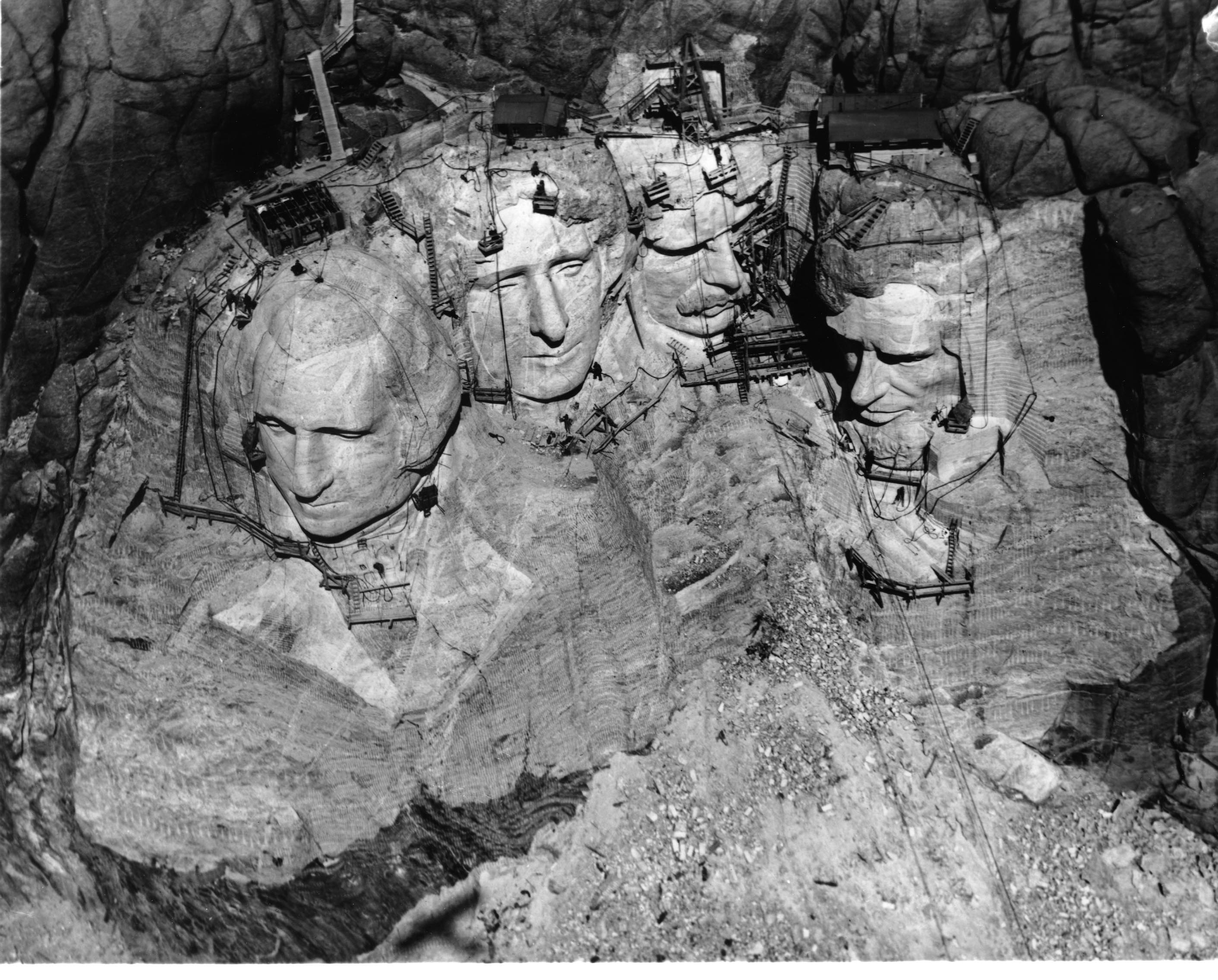

Work at Mount Rushmore in progress under the direction of Sculptor Gutzon Borglum.

Gutzon Borglum, the sculptor of Mount Rushmore, was born in the Idaho territory in 1867. His family moved to Nebraska while he was still young where his father established a medical practice. He studied art and sculpture in Paris at the Julian Academy, where he met and was influenced by famous French sculptor Auguste Rodin. Borglum had built a reputation for several patriotic works of art, ranging from a bronze memorial statue at Gettysburg of confederate soldiers from North Carolina, to a six ton marble head of President Lincoln that was exhibited in the White House during Theodore Roosevelt’s Presidency.

    Work on Mount Rushmore started in 1927. After 13 and a half years of work, Gutzon died in March 1941 before Mount Rushmore was finished. His son Lincoln, supervised some finishing touches on the faces through the Fall of that year. Shortly thereafter, the United States entered World War II and with the country’s resources being devoted to the war effort, further work stopped.

     Over the decades, Mount Rushmore has become a familiar symbol of America, recognizing 4 of the greatest Presidents of the United States. Each year over 3 million people come to witness in person one of the greatest historic memorials and artistic ingenuities in American History.


“The purpose of the memorial is to communicate the
founding, expansion, preservation, and unification
of the United States with colossal statues of
Washington, Jefferson, Lincoln, and Theodore Roosevelt." 
Gutzon Borglum


As we are honoring and remembering the Great Presidents that have help build and strengthen America, follow us the rest of Presidents Day Week as we share some highlights of each of those four Great Presidents seen on Mount Rushmore.


Snapshots Across America features Mount Rushmore as one of the attraction game cards that players can learn about as they travel across the game-board map of America:


Feb 7, 2016

The Super Bowl, Lady Gaga and Fort McHenry?

UPDATE:

What a beautiful combination: Super Bowl 50, Lady Gaga and the Battle of Fort McHenry!


I have to say, while I haven't really been a big fan of Lady Gaga in the past, I think that her performance of the Star Spangled Banner at Super Bowl 50 was one of the best and most honorable renditions of our National Anthem performed by a Pop Star that I remember.


To watch the video go to 


(Original post )

What an interesting combination: Super Bowl 50, Lady Gaga and the Battle of Fort McHenry


If you haven't heard yet, Grammy Award winning pop singer, Lady Gaga, is performing the National Anthem at this year's Super Bowl. When I heard that, my first reaction was.., well... um... this will be... interesting....

The NFL Network broadcast an interview of Lady Gaga with Nate Burleson, a former NFL player turned NFL broadcaster, Nate asked her about her performance, "Will there be any surprises?" 


She answered, “I have to live up to a song that stands the test of time. I think the best way to do that is kind of forget about yourself and just focus on what it means. You know if you listen to the lyrics of this song…. you know it’s just such a beautifully written song. And I think that I will be thinking about what it means.” She added, “I’m really singing it from the heart, and I’m also singing it really very true to the way that it was written, because I think that’s when it sounds its most majestic.”

I have to say I was actually quite surprised and rather inspired by her answer and actually look forward to her rendition.


While most Americans are very familiar with the “Star Spangled Banner”, many don’t know about the history leading up to Francis Scott Key penning those infamous lyrics while witnessing the Battle of Fort McHenry.


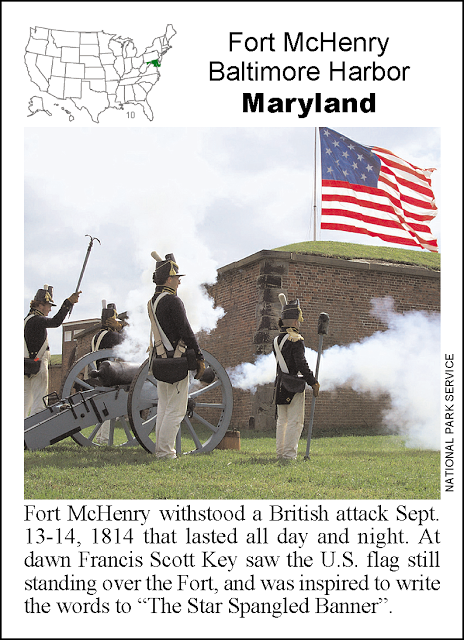
Honor Guard at Fort McHenry, Maryland
Photo: National Park Service

We go back to the War of 1812, which for the first couple of years, US forces were somewhat successful in many of the scattered skirmishes. However, after the British defeated NapolĂ©on in April 1814, they concentrated their efforts on the war against the newly independent United States. On August 24, 1814, the British took control of Washington D.C. and set the US Capitol Building and White House on fire. The British’s next target was the strategic port of Baltimore, Maryland.

As the British were advancing towards Baltimore, a series of rather unexpected events set into motion the strange circumstances where Francis Scott Key, a young American lawyer in Washington DC, witnessed the attack from behind enemy lines in the midst of the mighty British Naval fleet.

On August 28 an elderly Dr. William Beanes was wrongfully arrested by the British as a prisoner of war. Several of his patients persuaded Key to help get Dr. Beanes released. After getting diplomatic status from President James Madison, Key and his companion, John S. Skinner, a prisoner exchange officer, approached the British Fleet under a flag of truce on September 7, 1814. There they met with British Major General Robert Ross, who agreed to release Dr. Beanes. However, since the three Americans were then aware of the British’s attack on Baltimore, General Ross ordered that they be detained so that they couldn’t alert the U.S. forces. So the three Americans were being held captive behind enemy lines in the midst of the massive British fleet of over 50 ships.

On September 12, the British launched a ground attack on the East side of the harbor where, Major General Ross, who Key and Skinner had met with just days before, was mortally wounded. Later that day 16 British warships moved to within firing distance of Fort McHenry.


Arial Photo of Fort McHenry protecting the Baltimore Harbor.
Photo: National Park Service

Then at 6:00 am on September 13, British cannons, mortars, and rocket launchers opened assault on Fort McHenry. The battled raged all day and well into the night where rockets and exploding bombs lit up the smoky dark sky. At about 1:00 am under a blanket of night, the British unsuccessfully attempted a ground attack on the west. Throughout the night, the British continued firing at the fort. Despite the British launching an estimated 1,500 – 1,800 shells, mortars and rockets aimed directly at Fort McHenry, U.S. casualties were relatively small with only four deaths and twenty-four injuries out of approximately 1,000 defenders.

Before dawn, the fighting had ended signaling that the battle was over, but Key and his companions didn’t know who had won. Then as told through the immortalized words he wrote “O, say can you see, by the dawn’s early light,” Key experienced great elation which “Gave proof through the night that our flag was still there”.

Key, Skinner and Beanes were released from British detainment two days later. Key spent that first night of freedom in a quiet hotel room in Baltimore, editing the lyrics he wrote while aboard the enemy ship. The next day, on September 17, 1814, the Defense of Fort M’Henry was first published and distributed in Baltimore in the form of a handbill. Over the next few weeks, it was published in numerous US newspapers and was on its way to becoming one of America’s most beloved patriotic songs.

And that’s how a young American lawyer while being held behind enemy lines, witnessed and was inspired by one of the greatest battles in US History, to write our National Anthem. So the next time you hear or sing the Star Spangled Banner, whether while watching the Super Bowl 50 or even a hometown high school game, perhaps you may know a little bit more about its history and better understand the meaning and significance behind those familiar words.


Fort McHenry National Historical Site is one of the attractions featured in the educational game, Snapshots Across America. 


Feb 6, 2016

The World Tunes in to San Francisco

This weekend the whole World will be tuning in to the San Francisco area, home to Super Bowl 50, which is also home to one of the most recognized landmarks in the United States.
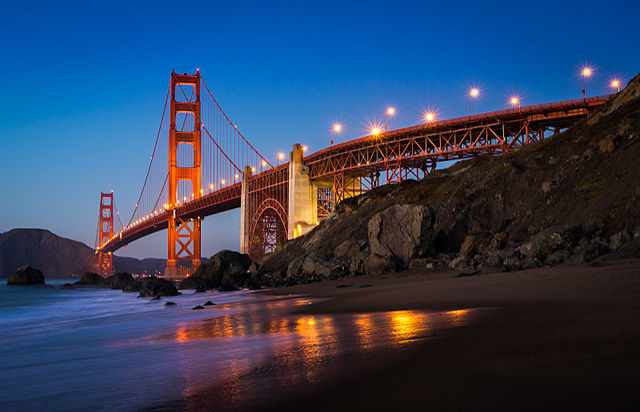
The Golden Gate Bridge, San Francisco, California.
Photo by Ryan J Wilmot CC-BY-SA-4.0
The Golden Gate Bridge took a little over 3 years to build, from January 1934 to April 1937 and was then opened in May 1937. Measuring 4200 ft between the two towers, it was the longest main span suspension bridge in the world at that time and held that record until 1964, but still is the 2nd longest suspension bridge in the United States. 

This coming weekend (February 7, 2016) the Denver Broncos take on the Carolina Panthers in Super Bowl 50, which will be played at the new San Francisco 49'ers home in Levi's Stadium located in Santa Clara, California. Kickoff is slated for 6:30 p.m. on CBS.

 The Official Super Bowl 50 Media Guide,  claims that it will be "the biggest Super Bowl the NFL has ever celebrated,.." and will be "big: load, proud, inclusive and authentic, just like the Bay Area itself."1


The Golden Gate Bridge is one of the attractions featured on a card in the Educational Board Game, Snapshots Across America.
SAVE 20% 

on the Snapshots Across America
Educational Expanded Edition.


Jan 28, 2016

Remembering The Space Shuttle Challenger

Its hard to believe that its been 30 years since that fateful Tuesday Morning at the Kennedy Space Center in Florida. 
Photo credit: NASA. 
January 28, 1986: It was the 25th Space Shuttle Mission, and the 10th mission of the Challenger. It had launched like any other of the previous 24 missions, including 9 previous launches of the Challenger. 73 seconds after blast-off the unthinkable happened. The Shuttle exploded, along with 7 passengers, including Christa McAuliffe, a High School Teacher from New Hampshire that had been selected from 11,000 applicants to become the first Teacher in Space.

 The crew aboard the Space Shuttle Challenger on January 28, 1986.
Crewmembers were (left to right, front row) Michael J. Smith, Francis R. (Dick) Scobee and Ronald E. McNair; (back row) Ellison S. Onizuka, Sharon Christa McAuliffe, Gregory Jarvis and Judith A. Resnik
. Photo: NASA

The 113th Space Shuttle Mission of the Columbia also exploded, breaking up on re-entry on February 1, 2003 scattering debris over a 100 mile stretch of Texas and Louisiana.

There were a total of 135 Space Shuttle Missions spanning over a period of 30 years. The first being the Columbia lifting off on April 12, 1981, and the last was the Atlantis lifting off on July 8, 2011.

Snapshots Across America features the Kennedy Space Center Visitor Complex. In June of 2013, the New Space Shuttle Atlantis Exhibit opened up at the Kennedy Space Center Visitor Complex featuring the actual retired Atlantis Shuttle as the centerpiece.


A video from NASA about the Kennedy Space Center Visitor Complex.


Jan 23, 2016

Jonas Blizzard Buries Northeastern U.S.

    WEATHER ALERT!    
Snow Blizzard Buries Northeastern U.S.


Winter Storm Jonas buries Washington D.C.
Statue of James Garfield with U.S. Capitol Building in the Background.
Photo taken January 23, 2016 by Geoff Alexander via Flickr. CC BY-2.0


If you have watched the Weather Channel at all the past day or two, you should know that the Snow Storm they have named "Jonas" has buried the Northeastern United States. As of Saturday evening (Jan. 23), the Weather Channel is reporting that Washington DC, Baltimore, New York and many other cities in the Northeast have had over 2 feet of snow.


Here are some other photos:


Queens, New York.
Photo taken January 23, 2016 by John Gillespie via Flickr. CC BY-SA-2.0

Howard Street in Baltimore, Maryland.
Photo Taken January 23, 2016 by Seth Sawyers via Flickr. CC BY-2.0.

But after all, weather happens. It’s been happening for thousands and even millions of years, and depending upon the physical geography of where you are, sooner or later you are going to experience some type of severe bad weather. Whether that weather (pun intended) is a brutal blizzard in the Northeast, upper Midwest or Rocky Mountains, a hurricane along the Gulf or Atlantic coast, a tornado in the Great Plains, flooding along the Mississippi River, a heatwave in the South, or a draught in the West leading to devastating forest fires: weather happens. Yes, WEATHER HAPPENS! And so far all we can do about it is try to predict it, be prepared for it, respond to it and basically just deal with it.

When my wife and I were creating the Dr. Toy Award Winning educational board game Snapshots Across America, we wanted to have a fun “gotcha” factor to create interactive competition with players. Since players are “traveling” across a game board map of the United States to visit tourist attractions from all 50 States, we thought what if your “vacation” got ruined by “bad weather”.

So we introduced “bad weather” cards like this one that would cancel another players vacation to any of the States shown on the card.

Snapshots Across America features other different “Weather Alerts” for different regions around the United States that can be played to “spoil” another player’s vacation to one of the States affected by that bad weather. 

But one of the real benefits of this aspect in our game is it also gives families an opportunity to start talking with their children about what happens if you face or have to experience bad weather. What types of potential bad weather happen in your area? How do you protect yourself in a storm? Do you have an emergency plan? Do you have backup power, heat or water? Do you have an emergency kit with flashlights, food, water and other necessities that might be needed?

A good source of information for what you may need in an the event of an emergency or severe weather is:


Jan 22, 2016

Snapshots Game Review by Love To Learn.

Here's what Love to Learn says about Snapshots Across America:


Buy Snapshots Across America at:
http://www.lovetolearn.net/Snapshots-Across-America

http://snapshotsusagame.com/

Need A Vacation? Save 20%

SAVE 20% on
Snapshots Across America
now thru 2/7/16

At Checkout use discount code:

Homeschool


Snapshots Across America is the Dr. Toy Award Winning Game where players learn U.S. Geography while "travelling" across a game-board map of the United States to "visit" actual places from all across America.
Great for helping families learn U.S. Geography as well as about many great Landmarks, National Parks, Museums, National Monuments, Memorials, Historical Sites, and many other fun and educational attractions all across America.