Showing posts with label Historic Sites. Show all posts

Jan 22, 2016

Need A Vacation? Save 20%

SAVE 20% on
Snapshots Across America
now thru 2/7/16

At Checkout use discount code:

Homeschool


Snapshots Across America is the Dr. Toy Award Winning Game where players learn U.S. Geography while "travelling" across a game-board map of the United States to "visit" actual places from all across America.
Great for helping families learn U.S. Geography as well as about many great Landmarks, National Parks, Museums, National Monuments, Memorials, Historical Sites, and many other fun and educational attractions all across America.


Nov 24, 2015

Honoring the Pilgrims this Thanksgiving

Snapshots Spotlight:

Honoring the Pilgrims this Thanksgiving 


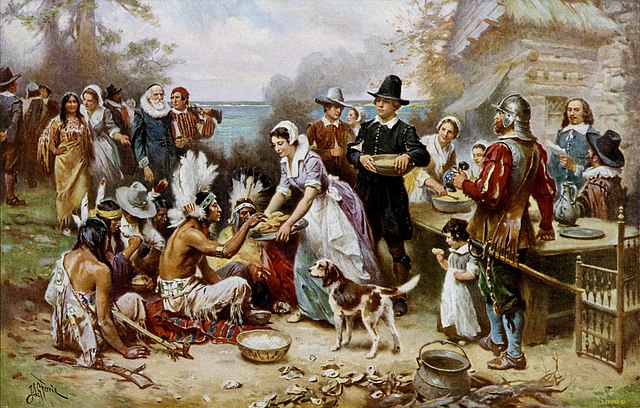
The First Thanksgiving 1621
by American Painter, Jean Leon Gerome Ferris
Source: U.S. Library of Congress
As we gather together with our families this Thanksgiving we honor the Pilgrims who traveled across the Atlantic Ocean to establish a Colony in the New World and to be free from religious oppression in England.

In trying to learn more about the Pilgrims, my mother-in-law, Laura Byers, told me about how her 11th Great Grandfather who was one of the 102 passengers who arrived in America aboard the Mayflower. Her ancestor, William Brewster, along with his wife Mary and 2 of their sons, at around 9 & 6 years old, made the long voyage to America, arriving in November of 1620. Strong winds drove the ship far off course, and rather than their original target of the Virginia Colony, they landed over 400 miles to the Northeast, in what is now Plymouth, Massachusetts.

That first winter was very harsh on the newly arrived Pilgrims, of which almost half died in the first year. But William, Mary, and their 2 young sons named Love and Wrestling, all survived that first harsh winter. 

That First Thanksgiving was a harvest celebration in which the surviving 53 Pilgrims along with Chief Massasoit and around 90 Native American Indians celebrated for 3 days the bounteous harvest that they had reaped during that first year in a new home. 1

Shortly after that First Thanksgiving celebration, the Brewster's oldest son, Jonathan later joined them in 1621 aboard the ship, The Fortune. Their 2 older daughters, Patience and Fear, also arrived at Plymouth in 1623. William Brewster, having served as an assistant pastor while the Pilgrims were in Holland, became Plymouth Colony's religious leader until 1629, and also an adviser to Governor William Bradford.


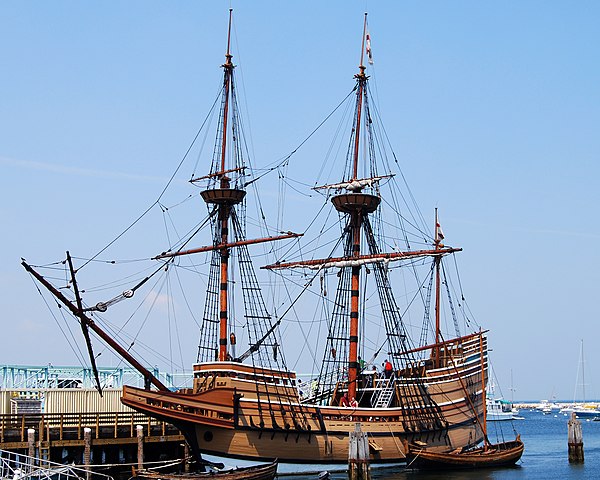
The Mayflower II, a replica of the original ship that brought the Pilgrims to America.
Source: Paul Keleher CC BY-2.0
The Mayflower II, which is a replica of the original ship that brought the Pilgrims to America, is docked in Plymouth. Tours are conducted by guides dressed in period clothes, which teach visitors about the historic ship and its famous voyage across the Atlantic Ocean.

The Mayflower II is one of the  Historical Attractions featured in
the educational board-game Snapshots Across America
.


Sources:
1. The Pilgrim Hall Museum. Plymouth, MA. 
http://www.pilgrimhallmuseum.org/thanksgiving.htm

2. The Plimouth Plantation. Plymouth, MA.
http://www.plimoth.org/what-see-do/mayflower-ii


Feb 13, 2015

Snapshots Spotlight: Honoring America's Great Presidents


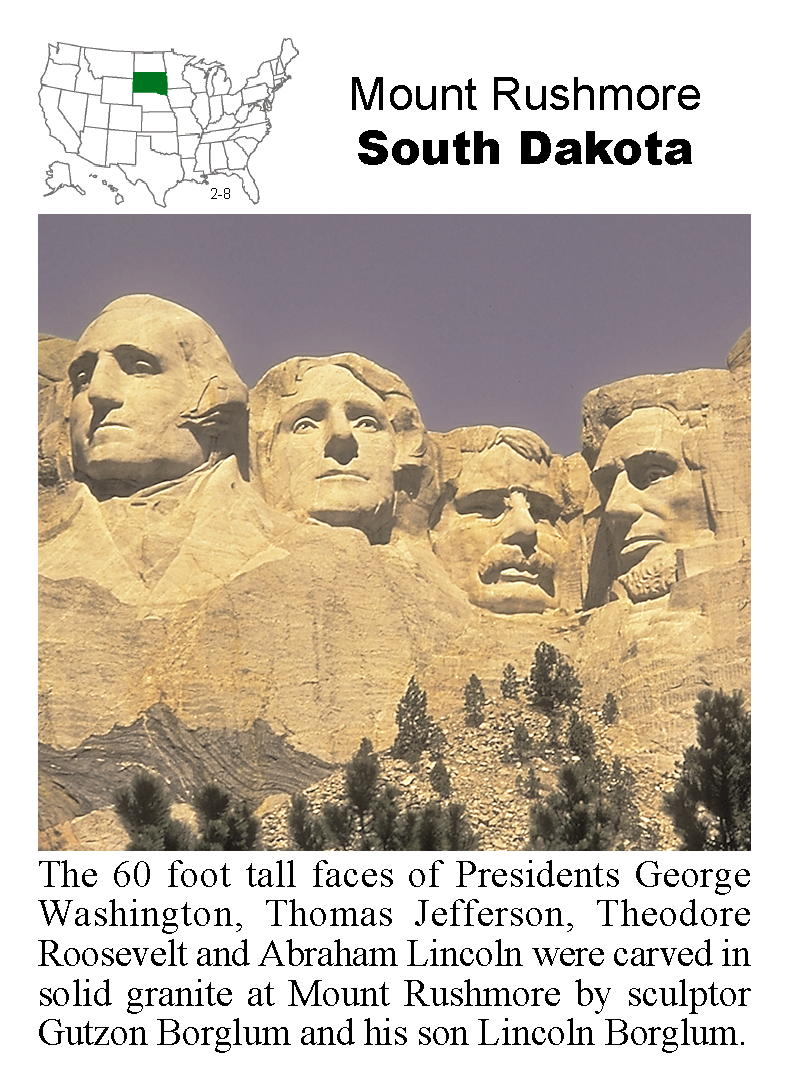
Mount Rushmore located in the Black Hills of South Dakota, features sculptures of four of the greatest Presidents of the United States: George Washington, Thomas Jefferson, Theodore Roosevelt and Abraham Lincoln.
Source: Used under License-Corel Photo CD.

Snapshots Spotlight: 

Honoring America's Great Presidents

     On Monday, February 16, 2015, we celebrate a holiday that has become known as “Presidents’ Day”. But is it more than just a day off of work or when businesses offer deals on appliances, carpet or furniture?

     The history behind Presidents’ Day goes back to the early 1800’s. After George Washington died in 1799, his birthday, which was February 22, was “unofficially” celebrated by many patriotic Americans in honor and remembrance of the first US President and the “Father of our Country”. However, it wasn’t until 1885, that Washington’s Birthday was officially established as a National Holiday celebrated annually on February 22.1

     The Uniform Monday Holiday Act, which went into effect in 1971, officially moved several Federal Holidays to Mondays, creating more “three day weekends” for families. One of the goals and arguments supporting the promotion of the change, was that three day weekends would stimulate the travel industry and increase business commerce. Hence the now common “Presidents’ Day sales”, really do have an actual historical origin in the law as it was supposed to be helping  to stimulate business and economical growth.2

     The new law changed the official date to celebrate Washington’s Birthday from February 22 to the third Monday in February. Depending upon how the calendar falls, it can occur between Feb 15 and 21. That date was chosen under a proposed provision in that Act that would combine the celebration with Abraham Lincoln’s birthday, which was February 12.1&2 

     Interestingly, the final draft of the bill dropped language and the reference regarding President Lincoln or other Presidents, and only recognized the Federal Holiday as “Washington’s Birthday”. However, since that time, many States, as well as popular tradition, have recognized and adopted the holiday as “Presidents’ Day”, honoring primarily both Washington and Lincoln, as well as other Presidents throughout history.2

    As we are honoring and remembering the Great Presidents that have help build and strengthen America, Mount Rushmore is the one place that memorializes 4 of the great Presidents, including both George Washington and Abraham Lincoln, who we are primarily recognizing on Presidents' Day.


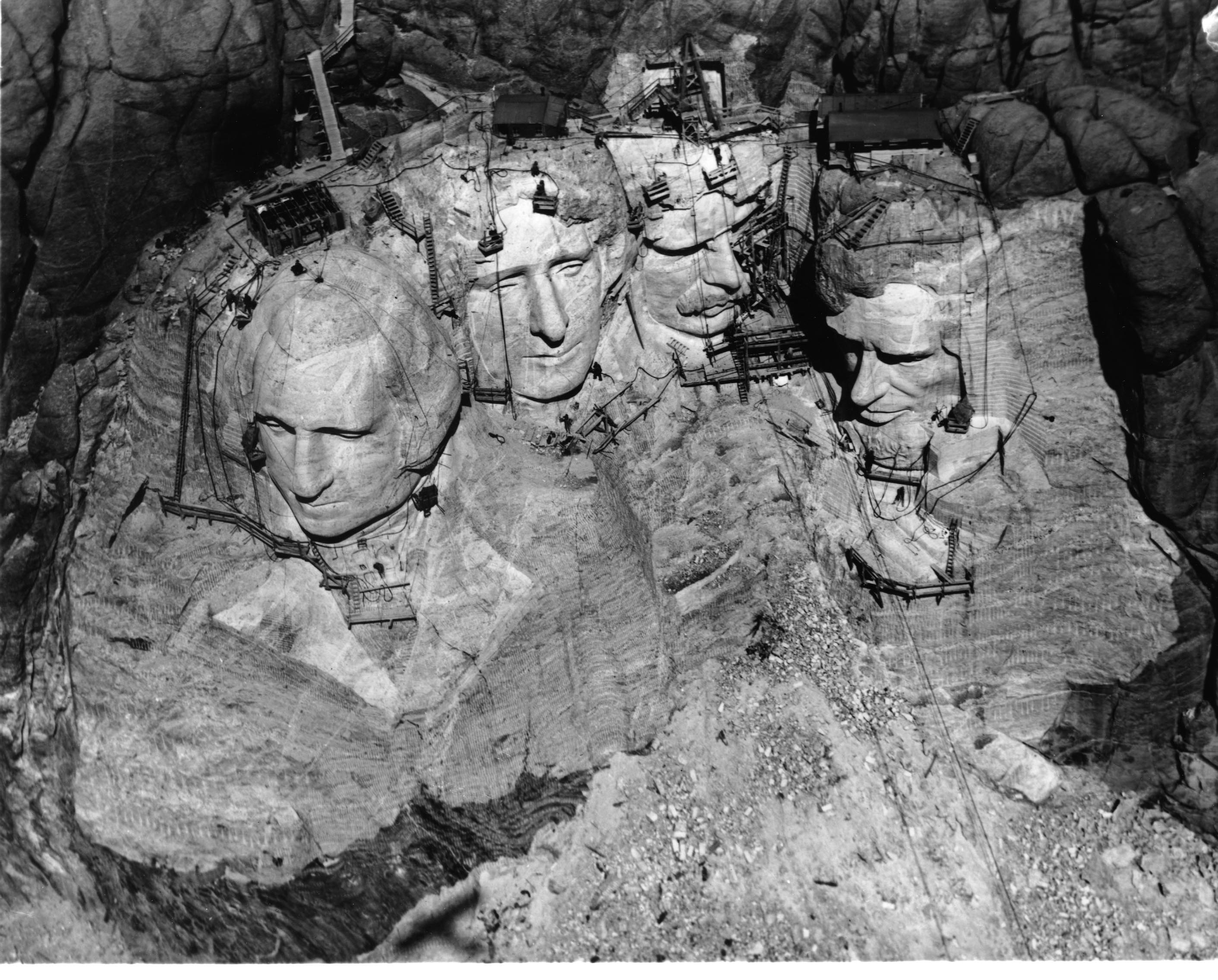
Work at Mount Rushmore in progress under the direction of Sculptor Gutzon Borglum.
Source: National Park Service Mt. Rushmore Historical Photos


“The purpose of the memorial is to communicate the
founding, expansion, preservation, and unification
of the United States with colossal statues of
Washington, Jefferson, Lincoln, and Theodore Roosevelt." 
Gutzon Borglum5

    
Gutzon Borglum, the sculptor of Mount Rushmore, was born in the Idaho territory in 1867. His family moved to Nebraska while he was still young where his father established a medical practice. He studied art and sculpture in Paris at the Julian Academy, where he met and was influenced by famous French sculptor Auguste Rodin. Borglum had built a reputation for several patriotic works of art, ranging from a bronze memorial statue at Gettysburg of confederate soldiers from North Carolina, to a six ton marble head of President Lincoln that was exhibited in the White House during Theodore Roosevelt’s Presidency.

    Work on Mount Rushmore started in 1927. After 13 and a half years of work, Gutzon died in March 1941 before Mount Rushmore was finished. His son Lincoln, supervised some finishing touches on the faces through the Fall of that year. Shortly thereafter, the United States entered World War II and with the country’s resources being devoted to the war effort, further work stopped.

     Over the decades, Mount Rushmore has become a familiar symbol of America, recognizing 4 of the greatest Presidents of the United States. Each year over 3 million people come to witness one of the greatest historic memorials and artistic ingenuities in 
American History.4
.
The Men on the Mountain

"Washington Crossing the Delaware" by Emanuel Leutze, Oil on Canvas,
on Display at the Metropolitan Museum of Art, New York.
     
     George Washington is recognized as the “Father of our Country” for his many roles in establishing the United States as an independent and free country. He was the General and Commander in Chief of the Continental Army during the Revolutionary War, leading his troops to victory over the British which established the Independence of the United States.

     He also presided over the Constitutional Convention which drafted the United States Constitution in 1787. He was then unanimously elected as the First President of the United States, and served two terms from 1789-1797.


Potrait of Thomas Jefferson by Rembrandt Peale
Source: White House Historical Association

     Thomas Jefferson is known for being the primary author of the Declaration of Independence as well as the Third President of the United States serving 2 terms from 1801-1809. He had served as Secretary of State for Washington’s first term and as his Vice President for the second term. During his Presidency he negotiated with the French for the Louisiana Purchase, which doubled the size of the United States territory and sent Lewis & Clark to explore the new added territory.


Portrait of Abraham Lincoln by George H Story
Source: The White House Historical Association
     Abraham Lincoln was the 16th President, serving from 1861 until his assassination in 1865. He is best known for his leadership during the Civil War and for the Emancipation Proclamation which ended slavery in the U.S. He is also famous for the Gettysburg Address, which was given four months after a key Union victory, where he reaffirmed the Nation’s commitment to equal rights, liberty, democracy, aboloshing slavery and preserving the Union. 


President Theodore Roosevelt and conservationalist John Muir
during a tour of Yosemite National Park in 1903.
Photo from The National Parks: Shaping the SystemNational Park Service.

     Theodore Roosevelt was the 26th President and a key political supporter of National Parks and Monuments, and was a key figure in preserving the natural wonder and beauty of America. Mt. Rushmore sculptor, Gutzon Borglum was a friend of “Teddy”, and believed that Roosevelt had a clear vision of the role of the United States in leading the world community as well as epitomized the true Spirit of America.4

Snapshots Across America features Mount Rushmore as one of the Attraction game cards:


For more information about Snapshots Across America, and the new updated edition to be release this coming Summer 2015, follow our blog or like us on Facebook


Copyright 2015, Sandell Games.


Feb 6, 2015

Snapshots Spotlights: US National Parks

Visitors observing the magnificent grandeur of the Grand Canyon National Park from
Mather Point on the South Rim. National Park Service Photo by Michael Quinn

Snapshots Spotlight 

US National Parks: An American Treasure


In the 2009 PBS documentary series, The National Parks: America’s Best Idea, Dayton Duncan and Ken Burns eloquently describe our National Parks: “They are a treasure house of nature’s superlatives---84 million acres of some of the most stunning landscapes anyone has ever seen…. But they are more than a collection of rocks and trees and inspirational scenes from nature…. [They are] where countless American families have forged an intimate connection with their land—and then passed it on to their children”.1

The first concept for setting aside large preservations of land of natural and cultural beauty is attributed to American painter and writer, George Catlin. During the 1830’s, Catlin travelled extensively through much of North America on an endeavor to capture the images on canvas of North American Indians and the wilderness they lived in. In 1842 Catlin published writings chronicling his adventures and suggested that the government should preserve what he called “a Nations Park” that would preserve and showcase the “pristine beauty and wildness… where the world could see for ages to come”.2,3

Yosemite National Park. The view of El Capitan on the left, Bridal Viel Falls to the right and Half Dome in the distant center.
Photo by DAVID ILIFF. License: CC-BY-SA 3.0
.

     As other travelers, painters and writers explored and witnessed the spectacular scenery of the expanding United States, the interest in preserving the majestic natural beauty of those areas grew. The first such area was Yosemite Valley, which in 1864, California Senator John Conness sponsored legislation which was signed by President Abraham Lincoln. That set aside Yosemite Valley as a protected land and under the control of the State of California, would become America’s first designated State Park. Later the Yosemite Valley would become part of the larger Yosemite National Park.2


Old Faithful Geyser, one of the most popular attractions in Yellowstone National Park,dwarfs visitors watching from nearby. National Park Service photo by Jim Peaco

The very first official National Park established in the United States, as well as the World, was Yellowstone National Park. During 1869-71, several expeditions ventured into the remote area of the territories of Wyoming and Montana. David E Folsom, Henry D. Washburn and Ferdinand V. Hayden had each explored the Yellowstone area and publicized their amazing geologic documentation of the many geysers, as well as other geothermic and geologic features present in the area. However since the proposed park was in a US territory rather than a state like Yosemite in California, it was established as a National Park under the protection and administration of US Federal Government. The bill passed Congress in 1872 and was signed into law by President Ulysses S. Grant.2

In 1875, Mackinac Island, located on Lake Huron in the state of Michigan, was designated as the second US National Park. However in 1895, it was transferred to the State of Michigan and become a State Park. In 1890, three National Parks were established in California: Yosemite, Sequoia and General Grant (which later became part of Kings Canyon National Park in 1940).2

Between 1899 and 1919, many other National Parks were established:
  • Mount Rainier National Park, Washington, 1899
  • Crater Lake National Park, Oregon, 1902
  • Wind Cave National Park, South Dakota, 1903
  • Mesa Verde National Park, Colorado, 1906
  • Glacier National Park, Montana, 1910
  • Rocky Mountain National Park, Colorado, 1915
  • Hawaii National Park, 1916, (Later split into Hawaii Volcanoes and Haleakala in 1960)
  • Lassen Volcanic National Park, California, 1916
  • Mount McKinley National Park, Alaska, 1917 (Later became Denali National Park in 1980)
  • Grand Canyon National Park, Arizona, 1919
  • Zion National Park, Utah, 1919.


President Theodore Roosevelt and conservationalist John Muir during a tour of
Yosemite National Park in 1903.
Photo from The National Parks: Shaping the SystemNational Park Service.

One of the greatest advocates for the establishment of Protected National Parks was conservationist and a founder of the Sierra Club, John Muir. Muir first travelled to the Yosemite Valley in 1869 to take a job working in a sawmill. However, his life was forever transformed by the natural beauty and grandeur he witnessed there. He has been described as the “patriarch for both the idea of wilderness preservation and the development of National Parks”.4

John Muir became instrumental in aiding the preservation of land for seven National Parks. In 1903 he gave President Theodore Roosevelt a tour of Yosemite National Park to see many of the magnificent views of the scenery there. President Roosevelt, after experiencing Yosemite and several other National Parks that year, would become one of the greatest political advocates and a primary supporter of  the National Parks, signing legislation that established five additional National Parks, and designated 18 National Monuments during his presidency.1


“Thousands of tired, nerve-shaken, over-civilized people
are beginning to find out 
that going to the mountains
is going home; that wildness is a necessity;
and that mountain parks and reservations are useful,
not only as fountains of timber and irrigating rivers,
but as fountains of life.”
 John Muir4                 


      The National Park System has grown significantly since it was first established. Currently there are 59 US National Parks that are a beautiful treasure of diverse gems scattered across 27 states and two US Territories. California has the most of any state with nine, Alaska is next with eight, Utah has five and Colorado with four.5

So why go visit a National Park? Sometimes just witnessing the immense beauty of nature can offer a great peace, strength and clear perspectives in life. Great people with an appreciation for some of the most awe inspiring places have gone before us to preserve these remarkable works of nature for us to see, value and appreciate. Experiencing and witnessing those magnificent National Parks, will give us the courage, the strength and the determination to continue to support, preserve and pass on those majesties of nature to the many future generations to come. So help support and preserve an American Treasure! Visit a National Park!

Snapshots Across America features these game cards:


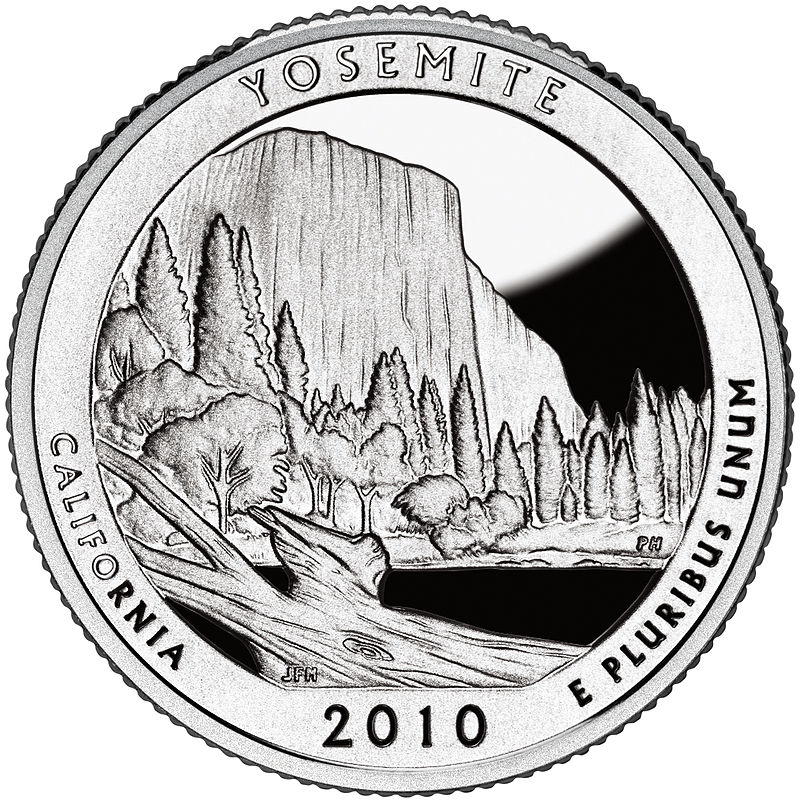
Yosemite, Yellowstone, and the Grand Canyon National Parks have also been featured on the new U.S. Mint America the Beautiful Quarters that were released in 2010.

Follow us for more Snapshots Spotlights about the many great tourist attractions 
featured in the educational boardgame, Snapshots Across America. New edition to be released Summer 2015.


Sources:
1Dayton Duncan & Ken Burns. The National Parks: America’s Best Idea. PBS Documentary Series aired 2009. Companion Guide. Alfred A. Knopf. New York. Print. 2009.

2Barry Mackintosh. The National Parks: Shaping the System. National Park Service-U.S. Department of the Interior. Washington, D.C. Print. 1991. Web.

3George Catlin. Letters and Notes on the Manners, Customs and Conditions of the North American Indians. Wiley and Putnam. New York. Print. 1842. Web.

4John Muir. Our National Parks. Houghton Mifflin and company. Boston-New York. Print. 1901. Web-Library of Congress.


5The official Website of the National Park Service. http://www.nps.gov/index.htm.
US Department of the Interior. Washington D.C. Web.


Copyright 2015, Sandell Games.

Jan 31, 2015

Snapshots Spotlight-Fort McHenry, Maryland

The Battle of Fort McHenry and the Super Bowl Connection

The Birthplace of a National Anthem


The Star Spangled Banner is one of the most performed songs in the United States, ranging from the smallest home town sporting events all the way to the largest televised event in America, the Super Bowl. While most Americans have repeatedly heard and quickly recognize the National Anthem, many may not know the unique circumstances nor the history leading up to Francis Scott Key penning the lyrics.

Peter Westmacott, the British Ambassador to the United States, in a guest Blog for the Smithsonian Institute describes Fort McHenry, Maryland as “hallowed ground in United States history… as the scene of a siege during the War of 1812,” which was witnessed by “Francis Scott Key, whose eloquent impressions later became known as the Star Spangled Banner.”1

We go back to the setting during the War of 1812, which the Smithsonian’s website describes as “a relatively little-known war in American History” involving the British and a young United States. The first couple of years during that war, US forces were somewhat successful in many of the scattered skirmishes. However, after the British defeated NapolĂ©on in April 1814, they concentrated on the war against the United States. On August 24, 1814, the British took control of Washington D.C. and set the US Capitol Building and White House on fire. This was a demoralizing blow to the United States and the British’s next target was the strategic port of Baltimore, Maryland.2


As the British were advancing towards Baltimore, a series of rather unexpected events set into motion the strange circumstances where Francis Scott Key, a young American lawyer in Washington DC, witnessed the British attack on Baltimore, from behind enemy lines in the midst of the British Naval fleet.3

On August 28 an elderly Dr. William Beanes was arrested as a prisoner of war in response to several British soldiers being thrown into a local jail for accusations of pillaging and plundering Dr. Beanes’ and other’s homes. Friends and patients of Dr. Beanes persuaded Attorney Francis Scott Key to help get Dr. Beanes released. After getting permission and diplomatic status from President James Madison, Key and John S. Skinner, an official US prisoner exchange officer, approached the British Fleet under a flag of truce on September 7, 1814, to negotiate for Dr. Beanes’ release. There they met with British Major General Robert Ross, who agreed to release Dr. Beanes. However, since the three Americans were now aware of the British planned attack on Baltimore, General Ross ordered that they be detained until after the attack, so that they would not be able to alert the U.S. forces. So Key, Skinner and Dr. Beanes were caught up behind enemy lines in the midst of the massive fleet of over 50 enemy British Naval ships preparing for one of the biggest battles in the War of 1812.3

On September 12, the British launched a ground attack from the East side of the harbor that met significant resistance by the 3rd Baltimore Brigade under the command of U.S. General John Stricker. In the ground Battle of North Point, Major General Ross, who Key and Skinner had met with just days before, was mortally wounded. Despite their losses, the British forced their way to about two miles from Baltimore before holding their position awaiting for the British Navy to capture Fort McHenry. Later that day 16 British warships moved to within firing distance of that strategic fort that protected the Baltimore Harbor.

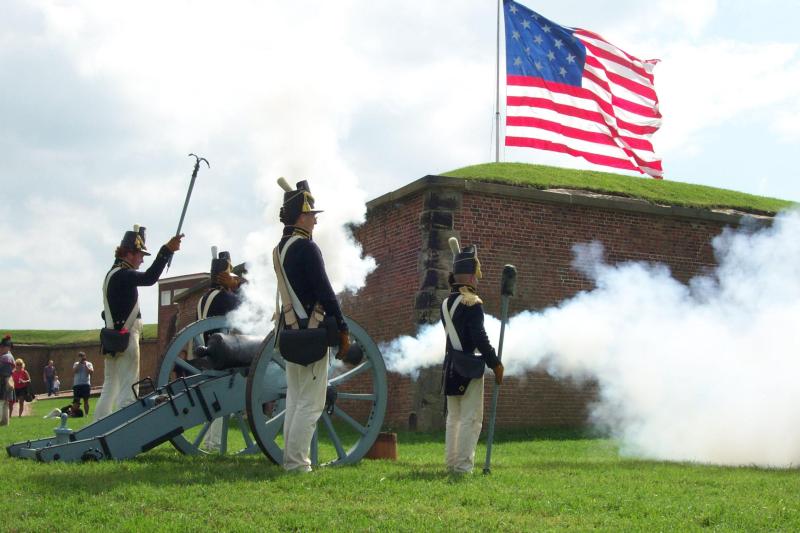
National Park Service Photo


 At 6:00 am on September 13, British cannons, mortars, and rocket launchers opened fire on Fort McHenry. Later in the day, three British warships approached the fort, but hastily withdrew after heavy US canon fire was returned. The battled raged all day and well into the night where rockets and exploding bombs lit up the smoky dark sky. At about 1:00 am under a blanket of night, the British attempted to land ground forces to the west of Fort McHenry. But two nearby batteries of US guns at forts Babcock and Covington, fired heavily for nearly two hours, turning back the enemy barges in their unsuccessful maneuver to make landfall and initiate a ground offensive from the backside. Throughout the night, the British continued with sporadic shells and rockets aimed at the fort.4

Despite the British launching an estimated 1,500 – 1,800 shells, morters and rockets aimed at Fort McHenry, US casualties were relatively small with only four deaths and twenty-four injuries out of approximately 1,000 defenders.5

Before dawn, the fighting had ended signaling that the battle was over, but Key and his companions didn’t know who had won. Then as told by the immortalized words he wrote “O, say can you see, by the dawn’s early light,” Key experienced great elation which “Gave proof through the night that our flag was still there”6.

Key, Skinner and Beanes were released from British detainment two days later on September 16. Key spent that first night of freedom in a quiet hotel room in Baltimore, finalizing his draft of the lyrics. The next day, on September 17, 1814, the Defense of Fort M’Henry was first published and distributed in Baltimore in the form of a handbill6. Over the next few weeks, it was published in numerous US newspapers and well on its way to becoming one of America’s most beloved patriotic songs. On March 3, 1931 The Star Spangled Banner was established by Congress as the official National Anthem of the United States of America.5

And that’s how a series of rather unusual circumstances, put a young American lawyer behind enemy lines to witness and be inspired by one of the greatest battles in US History, and Fort McHenry became the birthplace of a National Anthem. So the next time you hear or sing the Star Spangled Banner, whether while watching the Super Bowl or a hometown high school game, perhaps you may know a little bit more about its history and better understand the meaning and significance behind those familiar words.


The Snapshots Across America Game Card for Fort McHenry, Baltimore, Maryland.


Fort McHenry, Maryland is also featured on the new U.S. Mint America the Beautiful Quarters and was released into general circulation on August 26, 2013.


Follow us for more Snapshots Spotlights about the many great tourist attractions
featured in the educational boardgame, Snapshots Across America.

New Boardgame Edition to be released Summer 2015.


Copyright 2014-15, Sandell Games.


Sources:
1Sir Peter Westmacott. “Remembering the War of 1812.” Smithsonian Institute-National Museum of American History. Guest Blog. 18 Sept. 2014.

2National Museum of American History.  “The Star Spangled Banner, the Flag that Inspired the National Anthem.” Smithsonian Institute. Web. 18 Sept. 2014.

3Sam Meyer. Paradoxes of Fame-The Francis Scott Key Story. Annapolis, Maryland. Eastwind Publishing, 1995. Print. Pgs. 35-42.

4Harold R Manakee. “Anthem Born in Battle”. Star Spangled Books-Books, Sheet Music, Newspapers, Manuscripts and Persons Associated with “The Star Spangled Banner”. Eds. P. W. Filby and Edward G. Howard. Maryland Historical Society. Baltimore, Maryland. Print. 1972. Pgs. 29-39.

5Harold I. Lessem and George C. Mackenzie. “Fort McHenry-National Monument and Historic Shrine.” National Park Service Historical Handbook Series No. 5. Washington DC. National Park Service. Print. 1954. Web.

6Francis Scott Key. Defense of Fort M’Henry. Baltimore, Maryland. Circa 17 Sept. 1814. Library of Congress. Web. 

Fort McHenry National Monument and Historical Shrine website:
http://www.nps.gov/fomc/index.htm

US Mint America the Beautiful Quarters Websites:
http://www.usmint.gov/mint_programs/atb/
http://www.usmint.gov/mint_programs/atb/?local=FortMcHenry